
What if a single image concealed an entire story? Three frozen figures, a still setting, a creeping doubt… The enigma is deceptively simple: among these silhouettes, who is still breathing? We think we see the obvious, we think we’ve got it figured out, then a tiny detail throws everything into disarray. It’s neither a cruel trap nor a scientific experiment: just an invitation to look differently, calmly, like a detective who knows that the truth lies in the millimeters.
The puzzle, step by step: where to look
Your first instinct should be to scan the scene from left to right, without immediately focusing on faces. Observe the shadows, the folds of clothing, the position of hands, the way the light falls. Then, concentrate on the “forgotten” areas: under the table, near a chair, on the floor. It’s often there that the crucial clue lies hidden , the one we ignore because we expect a major sign, when in fact it’s a subtle hint.
The revelation (without sensationalism)
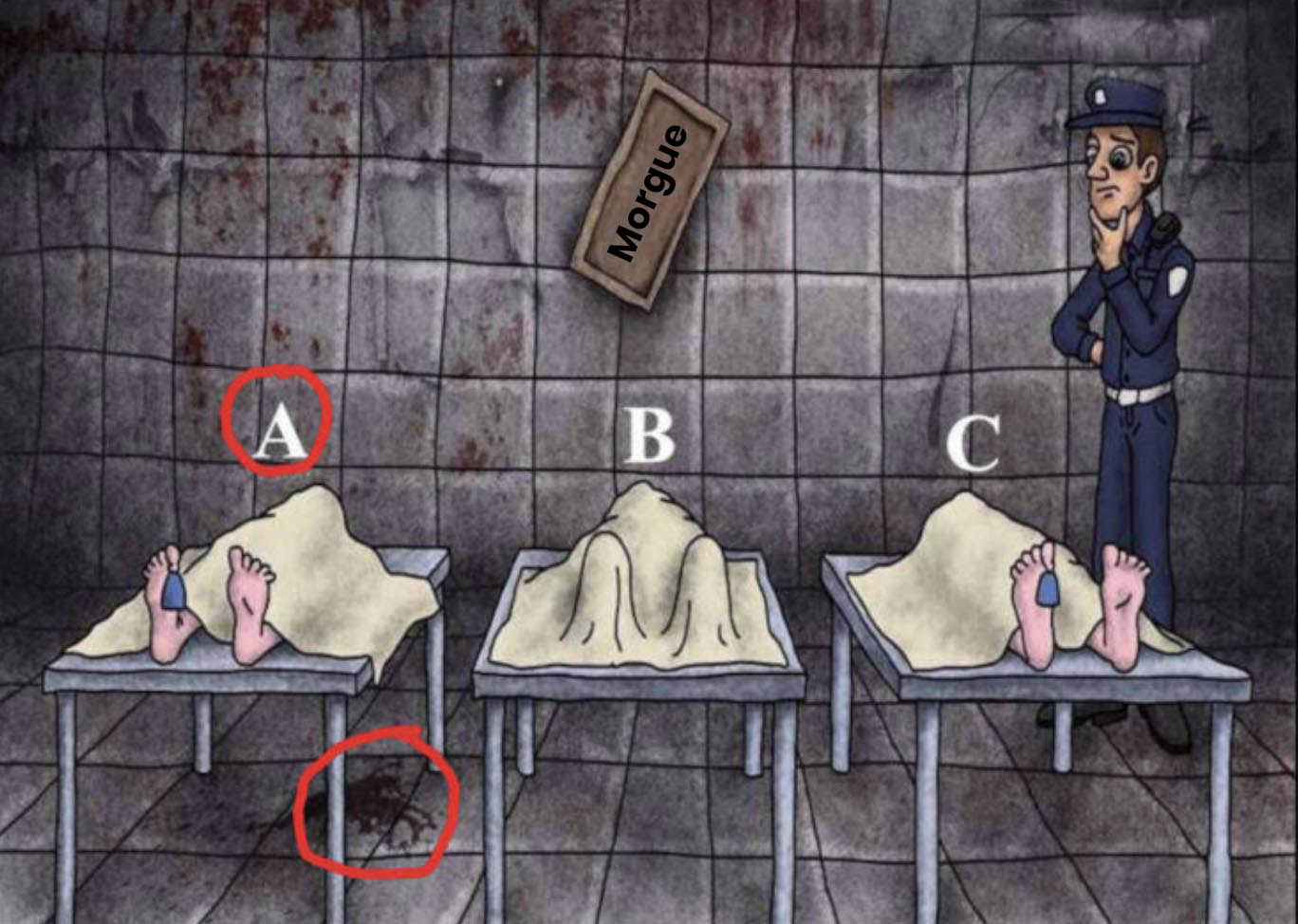

Person A is the only one still alive. Why? A tiny clue on the floor, under the table, betrays activity… alive. This small mark isn’t dramatic: it simply suggests that circulation is still functioning. In short, something discreet but real is happening, the kind of signal that doesn’t exist when everything is completely shut down. Our intuition often associates this type of mark with bad news; here, it’s the opposite: it’s proof of an organism that’s still active.
Why our brain made a mistake (and that’s normal)

Our brains love shortcuts: faced with a still scene, we rush to the most visible element (a closed gaze, a stiff posture, dark clothing) and “conclude.” However, the human eye excels at spotting the spectacular, less so at detecting the subtle. Add to that our mental scripts—TV series, detective stories, thrillers—and we overestimate “dramatic” clues, when the solution often lies in an almost insignificant detail. Tip: when you think you’ve found it, do a second reading in reverse (from bottom to top); you’ll see other things.
Mini eye training (to be done in 60 seconds)
- Adjust your “zoom”: move away from the image, then move closer.
- Count 5 concrete elements: objects on the ground, reflections, corners, junctions, lines.
- Look for the “gentle anomaly”: a small logical discrepancy (recent trace, inconsistent reflection, fold oriented in the opposite direction).
- Ask the magic question: What could not exist if everything were totally still?
- Give yourself a 10-second pause, then look again: the answer often jumps out at you on the second look.
What this enigma teaches us about real life
- First impressions are not verdicts: they open the door, but they don’t decide.
- Taking two breaths and observing with a cool head changes everything (at the office, with family, in love).
- Gentle logic beats the spectacular: the best clue is often the smallest, not the loudest.
Cognitive Wellbeing Bonus
Solving puzzles is like doing squats for your brain—without breaking a sweat! Observation, working memory, mental flexibility: everything gets activated. The good news is, a few minutes a day is all it takes. Slip a visual puzzle between emails, a Sudoku on your commute, a spot-the-difference game at breakfast: your mind will thank you, and so will your patience.
Quick FAQ
Why do these challenges captivate us so much?
Because they tickle curiosity and activate the reward circuit: finding is satisfying.
Is it useful on a daily basis?
Yes: we gain in concentration, rigor and perspective, three superpowers for managing the unexpected.
Should it be done every day?
Absolutely. Three to five minutes is enough to keep your mind sharp, without pressure or a stopwatch.
Now it’s your turn : will the next image also hold that little twist that changes everything?


0 Comments:
Enregistrer un commentaire