samedi 21 février 2026

3 important actions to remember in an emergency when you’re alone

by

When a heart atta:ck occurs, every second counts. What many people don’t know is that 70% of heart atta:cks happen when the person is alone , and more than 90% don’t reach the hospital in time. The heart can fail without war:ning, but if you know what to do in the first few moments, your chances of survival increase significantly .

Science and experts agree on one thing: you don’t need medication or equipment , just to stay calm and use simple emergency techniques. These maneuvers can keep your heart pumping while you wait for help or head to safety.

Below you will learn three proven actions that could help you survive a heart attack when no one is around. You can also see these techniques in the following video from the Healthy and Positive channel:

 When the heart starts beating irregularly, it’s common for a person to feel dizzy, weak, have cold sweats, or experience intense pressure in the chest. At that moment, a simple technique can provide valuable seconds: forceful, repetitive coughing .

How to do it?

  • Take a deep breath .
  • Then cough forcefully, as if you were trying to expel something trapped in your lungs.
  • Repeat every 2 seconds, keeping the rhythm.

This type of cough increases pressure within the chest and helps keep blood flowing to the brain. It’s not a cure, but it can maintain circulation long enough to call for help or get to safety.


2. Apply pressure to the correct point on the chest
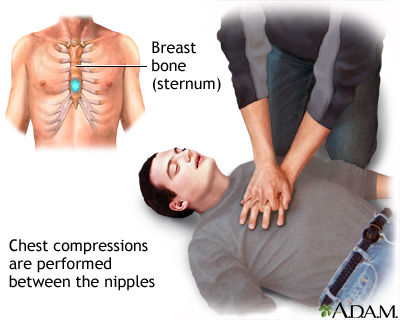
CPR - adult - series—Chest compressions: MedlinePlus Medical Encyclopedia

In some cases, when the heart begins to fail, a quick mechanical stimulus can help restart an irregular heartbeat. This maneuver is known to specialists as an “emergency stroke.”

How to do it?

  • With your hand closed, locate the center of the chest, just above the sternum .
  • Give a firm, non-violent blow , but strong enough to generate a stimulus.
  • It should only be done once and as an extreme measure , when you experience symptoms of an impending cardiac arrest (loss of strength, blurred vision, difficulty breathing).

This blow can help the heart regain a more stable rhythm while you manage to get professional assistance.

3. Stimulate the emergence point in the hand

There is a point frequently used in Eastern first aid techniques that can help you maintain consciousness for a few crucial seconds . It is located on the hand, between the thumb and forefinger.

How to activate it:

  • With your other hand, press firmly on the fleshy area between your thumb and index finger.
  • Maintain firm pressure for several seconds and repeat if necessary.
  • This stimulation helps activate the nervous system and keep you alert, especially if you start to feel faint.
  • It does not replace any medical care, but it can give you the time you need to ask for help

Emergency service - Wikipedia

Call an emergency service immediately if you can.

  • If you feel you are going to lose consciousness, get into a safe position.
  • Use these techniques only as support until professional help arrives.
  • Don’t drive if you think you’re having a heart attack: it could be fatal.

High Blood Pressure Dr.ug Linked to Heart Failure, Study Shows

by

Beta blockers are drugs that reduce high blood pressure and are prescribed for adults who suffer from hypertension, a leading cause of heart disease. According to a study published in Hypertension, researchers from the University of Bologna found that women taking beta-blockers for high blood pressure have a nearly 5% higher risk for heart failure than men when they present to hospitals with acute coronary syndrome.
 

According to psychologists, there are eight types of family members you should avoid in old age.

by


 As we get older, our perspective on life changes. We become more aware of the passage of time and realize the importance of using it wisely. But even if we carefully choose our leisure activities, projects, or even our diet, what about the people around us? Some family relationships we considered inevitable may turn out to be exhausting. And what if, with increasing maturity, it is time to reconsider the rules of the game?

The constant complainer: Enough with the eternal joy killer!

Do you know that family member who always finds something to criticize? Whether it's your hairstyle, your career choice, or the way you cook pasta? These constant comments eventually become simply exhausting. The solution? Set clear boundaries and calmly say what you no longer want to hear. An argument is not necessary: ​​often, simply taking a clear stand is enough to get the message across.

This person ignores your boundaries: No means no.
They show up unannounced, invite themselves over without warning, or intrude on topics you’d rather keep private. This “relationship bulldozer” doesn’t understand the word “no.” To maintain your peace of mind, firmly—and guilt-free—repeat the same answers. Your boundaries need to be respected.

The King of Mental Confusion: Pay Attention to Your Balance

The emotional manipulator questions everything: your memories, your feelings, your emotions. With insidious phrases like “You’re exaggerating” or “You’re just imagining it,” they make you doubt yourself. If the conversation is going in circles and going nowhere, protect yourself by limiting communication to the absolute minimum.

The Troublemaker: The art of ruining meals.
At every family gathering, he finds a way to revive old conflicts, provoke others, or create tension, even when everything was going so harmoniously. What to do? Don't interfere. Don't repeat his remarks and don't get dragged into his arguments.

The ultimate “taker”: a one-way street.
You’re always there for them: helping, lending money, listening… but you get nothing in return. This unbalanced relationship will eventually wear you out. Being generous is not wrong, but you also have to think about yourself. And sometimes that means ending one-sided relationships.

The person who never admits his mistakes: an impossible dialogue.

He may hurt, lie, or cheat, but he never apologizes. And most importantly, he never changes. This refusal to examine himself strains family bonds and hinders any progress. In this case, distancing is often a necessary protective measure.

The value-shy person: Your beliefs are not up for debate.
He criticizes everything that matters to you—your life choices, your beliefs, your passions—often under the guise of humor. If his remarks hurt you and he refuses to change his tone, it's perfectly legitimate to distance yourself from him.

High Risk Profile: Extreme caution is advised.
Some behaviors can be particularly destabilizing, especially if they stem from deep-seated, untreated stress. If the person refuses help or support, you have the right to protect yourself. Written communication can sometimes be sufficient to maintain contact while maintaining a safe distance. 

A Month Before a Stroke, Your Body Warns You: 10 Signs Not to Ignore

by

Strokes often strike without warning, leaving little time to react and causing lasting impact on health and independence. These subtle signals a month before a stroke can build quietly, dismissed as stress or fatigue, heightening fear when daily activities feel off. Missing them adds unnecessary risk in an emergency.

Awareness of these potential signs a month before a stroke empowers quicker response. One might match what you’ve noticed—keep reading to learn more.

🤕 Sudden Severe Headache

A intense headache unlike any before can feel alarming and unrelenting. This potential sign a month before a stroke, sometimes called a thunderclap headache, signals possible vessel issues.

Many brush it off as migraine or tension.

But experts from the Mayo Clinic note it’s a key red flag.

Recognizing this sign a month before a stroke prompts urgent attention.

😵 Dizziness or Loss of Balance

Feeling unsteady or dizzy without reason disrupts simple tasks. As a possible sign a month before a stroke, it hints at blood flow problems to the brain.

Vertigo or inner ear issues get blamed first.

The American Stroke Association includes it in BE FAST warnings.

This sign a month before a stroke deserves quick evaluation.

👁️ Blurred or Sudden Vision Changes

 Vision blurring or doubling in one or both eyes creates confusion and hazard. This visual sign a month before a stroke can occur temporarily in TIAs.

Eye strain seems the easy explanation.

But it’s a common precursor according to reliable sources.

Spotting this sign a month before a stroke early matters greatly.

💪 Weakness or Numbness on One Side

Sudden weakness or numbness in the arm, leg, or face—especially one side—feels frightening. This classic sign a month before a stroke reflects interrupted brain signals.

Many wait, hoping it passes.

Research shows it’s often from a transient ischemic attack (TIA).

Addressing this sign a month before a stroke fast saves function.

😷 Facial Drooping

One side of the face sagging when smiling raises immediate concern. As a hallmark sign a month before a stroke, it appears in the FAST acronym.

Bell’s palsy gets considered sometimes.

The stroke.org emphasizes testing it right away.

This visible sign a month before a stroke demands action.

🗣️ Confusion or Speech Difficulty

Struggling to speak clearly or understand others isolates in moments. This cognitive sign a month before a stroke impairs communication suddenly.

Fatigue or distraction feels logical.

But it’s a critical warning per health experts.

Noting this sign a month before a stroke leads to timely help.

🚶 Difficulty Walking or Coordination Loss

Stumbling or lacking coordination turns routine movement risky. This motor sign a month before a stroke affects stability.

Inner ear problems seem plausible.

Sources like Cleveland Clinic link it to impending events.

This sign a month before a stroke shouldn’t be ignored.

😓 Persistent Fatigue

Unusual exhaustion despite rest drains motivation daily. While less specific, extreme fatigue can signal vascular strain as a subtle sign a month before a stroke.

Busy life takes the blame often.

Some studies connect it to reduced brain blood flow.

Monitor this potential sign a month before a stroke closely.

🤢 Nausea or Vomiting

Unexpected nausea, especially with headache, adds discomfort. This accompanying sign a month before a stroke occurs in some cases.

Food or virus suspicion delays recognition.

It’s noted alongside severe headaches in warnings.

Pairing it identifies a possible sign a month before a stroke.

🩹 Neck Pain or Stiffness

Severe neck pain, particularly with headache, worries many. Rarely, it relates to artery issues as an uncommon sign a month before a stroke.

Muscle strain feels more likely.

Medical sources mention vertebral artery dissection.

Don’t dismiss intense pain as this sign a month before a stroke.

What to Do If You Notice These Signs

Act immediately with these steps:

  • Use BE FAST reminder → Check balance, eyes, face, arms, speech, time.
  • Call emergency services → Don’t drive—get professional help fast.
  • Note the time symptoms started → Crucial for treatment options.
  • Avoid food or drink → In case medical procedures needed.
  • Share medical history → Inform responders of risks or medications.

Quick response improves outcomes dramatically.

Understanding TIAs as Warning Events

Transient ischemic attacks (TIAs), or “mini-strokes,” cause temporary symptoms identical to stroke but resolve quickly. They serve as major warnings, with high risk of full stroke soon after.

Conclusion

While many strokes occur suddenly, some people experience transient symptoms or subtle changes that could appear days to weeks prior, acting as alerts. These 10 potential signs a month before a stroke—from severe headaches and dizziness to vision issues and weakness—highlight the importance of listening to your body and seeking help without delay.

FAQ

Do all strokes have warning signs a month before?
No, most are sudden, but TIAs provide warnings in some cases, often within days or weeks.

What is the biggest warning sign a month before a stroke?
Sudden changes like one-sided weakness, speech issues, or severe headache—remember BE FAST.

Can these signs a month before a stroke be prevented?
Managing risks like blood pressure, cholesterol, and lifestyle reduces chances significantly.

Disclaimer: This article is for informational purposes only and is not a substitute for professional medical advice, diagnosis, or treatment. Always consult a qualified healthcare provider with any concerns about your health.


I never would have thought that burning rosemary could do that

by


Did you think rosemary was only good for flavoring a leg of lamb or roasted vegetables? Think again… This Mediterranean herb hides an astonishing, almost secret ritual capable of changing the atmosphere of a room in the blink of an eye. Some people even swear that after just a few minutes, the energy of the place—and their mood—is completely transformed. Intriguing, isn't it? Before revealing how and why this age-old practice is so fascinating, let's take a moment to understand what makes rosemary so special.

Why rosemary has fascinated people for centuries

Rosemary is one of those plants found in both cooking and ancient traditions. Used since antiquity around the Mediterranean basin, it was already valued for its powerful aroma and invigorating effect. Even today, it is readily associated with mental clarity, vitality, and an almost immediate feeling of freshness.

What makes it so interesting are its natural aromatic compounds. When they diffuse into the air, they create a unique atmosphere: warm, herbaceous, and deeply comforting. A bit like a walk through the garrigue on a summer's day, without leaving your living room.

Burning rosemary: what really happens?

When you gently burn a few sprigs of rosemary, the plant releases its fragrance in the form of a light smoke. And that's where the magic happens. Many describe a feeling of purifying the air, as if the room becomes more "breathable," cleaner. This ritual is often used to refresh oneself after a busy day or before a relaxing break.

Another frequently mentioned effect is a feeling of calm. The scent of rosemary is known to promote relaxation and help release accumulated tension. While not promising miracles, this simple gesture can certainly contribute to creating a  natural wellness ritual  conducive to calm and concentration.

Some people also notice that they feel more focused, more present, almost as if they had aired their home for a long time… but with an added touch of sunshine.

The benefits felt on a daily basis

Incorporating this ritual into your daily routine offers a simple and natural respite. Burning rosemary for a few minutes can:

  • to help create a calm and pleasant atmosphere,
  • to help relieve the stress of the day,
  • to support moments of reading, meditation or rest,
  • to give the impression of renewal in the house.

It's also a lovely way to slow down. You light it, you observe the smoke, you breathe… and you finally allow yourself a break, away from screens and notifications.

How to burn rosemary properly at home

Nothing could be simpler, but a few rules are essential to enjoy it peacefully.

  1. Use well-dried sprigs of rosemary, ideally freshly cut and then air-dried.
  2. Place them in a heat-resistant container (a ceramic bowl or a terracotta dish, for example).
  3. Light the tip, let it burn for a few seconds, then blow gently to obtain a soft smoke rather than a bright flame.
  4. Let the rosemary burn quietly for a maximum of five to ten minutes, in a well-ventilated room, without creating a direct draft.

No need to overdo it: as with a home fragrance, subtlety makes all the difference.

Little tips to know

For the best experience, choose high-quality rosemary, either from your own garden or purchased in bulk from an herbalist. Avoid leaving it burning unattended and ensure the smoke remains light and pleasant. If you are sensitive to strong odors, start with a very short burning time.

This ritual fits perfectly into a broader wellness routine: a warm herbal tea, soft music, a few stretches… and you're all set. Sometimes, just ten minutes and a few sprigs of rosemary are enough to transform the atmosphere of your home and enjoy the  benefits of burnt rosemary  in a moment of profoundly comforting calm.

Should You Only Eat Mussels in Months With an R

by

Should You Only Eat Mussels in Months With an R ….Here’s the Truth

You may have heard the old saying: only eat mussels in months that contain the letter “R.” That means September through April were considered safe, while May through August were supposedly off-limits.

But is that still true today?

Let’s break down where this rule came from — and whether it still matters in modern kitchens.

Where Did the “R-Month” Rule Come From?
Before refrigeration, strict food safety laws, and regulated shellfish farming, people relied on seasonal patterns to guide what was safe to eat. Coastal communities noticed two important things:

1. Mussels Taste Different in Summer
During warmer months, mussels enter their spawning season. This biological process can make their meat:

Softer
More watery
Less flavorful
So even if they weren’t dangerous, they simply didn’t taste as good.

2. Warm Water Means Higher Toxin Risk
Summer heat can trigger algal blooms (including red tides). Mussels are filter feeders, meaning they filter large amounts of water — and along with it, microscopic algae.

Some algae produce marine biotoxins, and these toxins:

Can build up inside mussels
Are not destroyed by cooking
Can cause serious illness
Without modern monitoring, avoiding shellfish during hot months was a practical safety rule.

What Modern Science Says Today

For Complete Cooking STEPS Please Head On Over To Next Page Or Open button (>) and don’t forget to SHARE with your Facebook friends

 What Modern Science Says Today

The good news? The old “R-month” rule is no longer a universal requirement.

✔️ Modern Farming & Refrigeration
Most mussels sold commercially today are:

Farmed under strict regulations
Harvested from monitored waters
Kept continuously refrigerated
This dramatically reduces spoilage and contamination risks.

✔️ Ongoing Water Quality Monitoring
In many countries, health authorities routinely test for:

Harmful algal toxins
Bacteria such as Vibrio
Overall water safety
If toxin levels rise, harvesting areas are temporarily closed. Mussels only enter the market when they meet safety standards.

✔️ Safety Depends on Handling — Not the Calendar
Today, safety comes down to:

Buying from reputable suppliers
Keeping mussels properly chilled
Cooking them thoroughly
Discarding any that don’t open after cooking
In other words, how mussels are handled matters more than what month it is.

So… Can You Eat Mussels in Summer?
Yes — you absolutely can.

As long as your mussels:

Come from regulated, monitored sources
Are properly refrigerated
Are cooked safely
They can be enjoyed year-round.

That said, in earlier times — before refrigeration and toxin testing — avoiding “non-R” months was a simple and clever survival guideline.

Final Takeaway
The “R-month” rule is mostly a historical tradition rooted in seasonal taste and safety concerns from a pre-refrigeration era.

Today, thanks to modern food safety systems and regulated aquaculture, mussels can be eaten safely in any month — including summer — provided they are sourced and prepared correctly.


After receiving the ashes of a deceased person, you should know this

by

Is it bad to have the ashes of a deceased person in your home?

The practice of keeping the ashes of a loved one at home is becoming increasingly common and is often done as a way to keep the memory of the deceased close.

Still, this decision can have different implications depending on each person’s religious or spiritual perspective.

In this article, we’ll explore what two approaches to the topic have to say: spiritualism and Christianity.

Perspective of Spiritualism

For Spiritism, d:eath is a transition in which the spirit separates from the physical body to continue its evolution on a spiritual plane.

During this process, the spirit can be influenced by the thoughts and emotions of loved ones on Earth.

From this perspective, preserving the ashes of a deceased person in the home could hinder the peace and progress of the spirit, especially if family members feel a deep attachment or have not been able to accept the passing.

For Complete Cooking STEPS Please Head On Over To Next Page Or Open button (>) and don’t forget to SHARE with your Facebook friends

 Discover more

health
family
door

Spiritism teaches that emotional attachment to material remains, such as ashes, can act as a bond that keeps the spirit connected to the earthly plane. This could be uncomfortable for the spirit, because its evolution neeeds freedom and detachment from material ties. For this reason, some followers of this doctrine believe that the best thing for the well-being of the deceased is to deposit the ashes in a suitable resting place or scatter them in nature, thus enabling the spirit to continue its journey unhindered.

Perspective of Christianity

For Christianity, it considers the body sacred and that d:eath is the beginning of eternal life in the presence of God. Traditionally, human remains are buried in a cemetery or sacred place, as a way of respecting the sacredness of the body. Though cremation was rejected in some Christian circles in the past, it is accepted today, as long as the ashes are treated with respect.

For example, In the Catholic Church, cremation is permitted, but it is recommended that the ashes be placed in a consecrated place, such as a cemetery or columbarium, and not kept at home . This is because the Church thinks that the cemetery is a fitting place to honor the deceased, and keeping the ashes at home could blur the meaning of respect and solemnity toward the body. In addition, a consecrated resting place also facilitates the grieving process by offering family members a space to visit and remember their loved one in peace.

Final reflection: a personal decision
In both Spiritism and Christianity, we find different reasons in order to reflect on the fate of a loved one’s ashes. Nevertheless, each person experiences grief in a unique way and finds solace in different practices. For some people, keeping the ashes at home can represent peace and closeness, while for other people, putting them in a consecrated place or scattering them in nature can symbolize liberation and an act of respect.

Ultimately, this is a deeply personal decision and needs to be respected. Each family and individual must analyze what they consider best, both for their emotional peace and to honor the memory of their loved one. The importance lies in the respect and love with which this choice is handled, and in how this practice makes contribution to the serenity of people who make it.


Why this “simple recipe” is misleading (and risky)

by


🦷 Tartar (calculus)

  • Tartar is hardened plaque.

  • Once it forms, it cannot be removed at home.

  • Scraping, acids, or DIY mixes can:

    • Damage enamel

    • Cause gum recession

    • Make teeth more yellow long-term

👉 Only professional dental cleaning removes tartar safely.

🍄 “Eliminates fungus” claim

  • Oral fungal infections (like thrush) require medical diagnosis and antifungal treatment.

  • Home remedies do not cure fungal infections and may make them worse.

⚠️ Common ingredients in these posts (DO NOT USE)

These are often hidden in the “recipe”:

  • Lemon or vinegar → acid erosion

  • Baking soda daily → enamel wear

  • Hydrogen peroxide misuse → burns gums

  • Salt scrubs → micro-scratches teeth

They may look white temporarily because enamel is damaged — not because teeth are healthier.

What actually works (and is safe)

✅ To prevent tartar buildup

  • Brush twice daily with fluoride toothpaste

  • Floss daily

  • Use an electric toothbrush if possible

  • Get professional cleanings every 6 months (or as advised)

✅ To whiten teeth safely

  • Dentist-approved whitening strips or gels

  • Professional whitening

  • Avoid staining drinks (coffee, tea, soda) or rinse after

✅ For bad breath

  • Clean your tongue

  • Stay hydrated

  • Treat gum disease if present

  • See a dentist if it persists

Bottom line

🛑 No drop, no DIY mix, no 3-use miracle removes tartar or cures oral fungus.
These posts spread misinformation and can permanently damage your teeth.